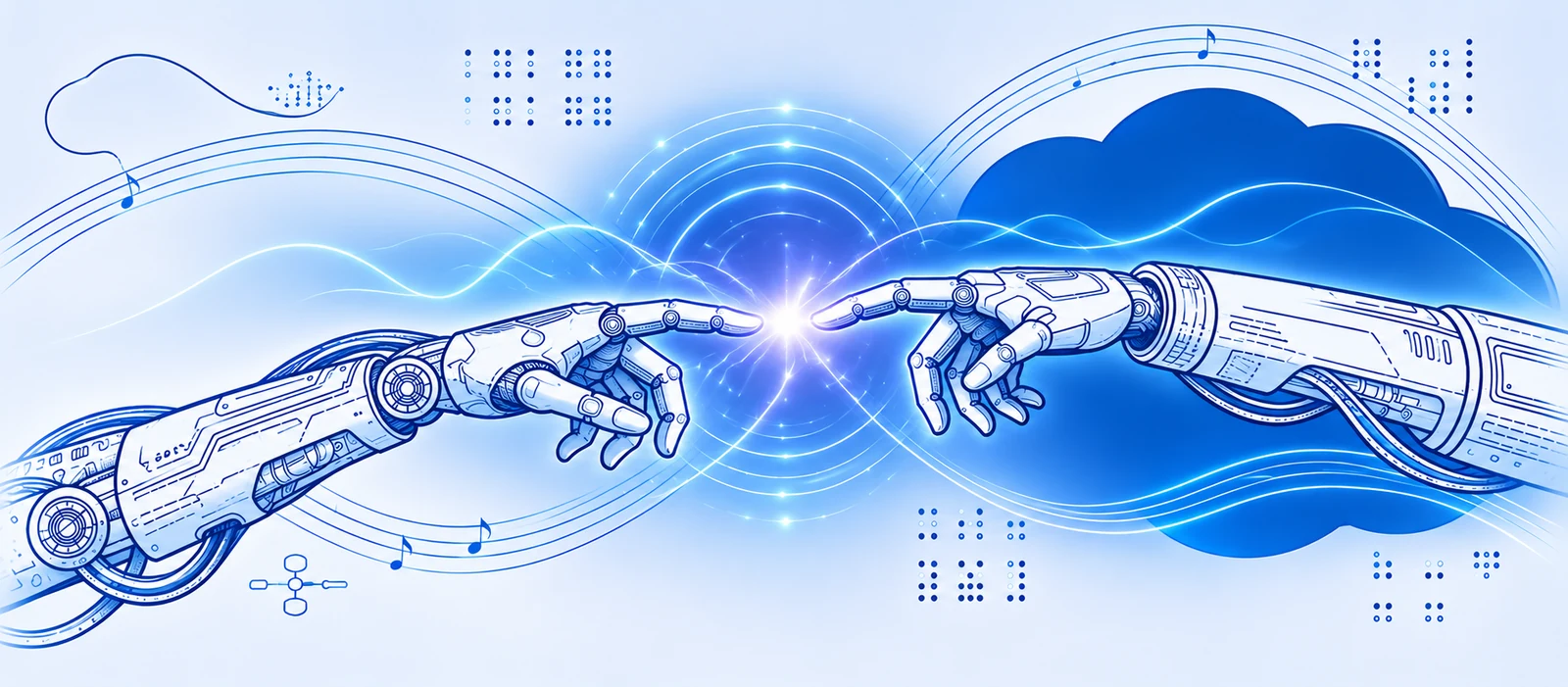
English is my second language. I can know what I mean and still struggle to find the words that will make someone else understand it, because the sentences I manage to put together do not always carry everything I wanted to say. In my native thinking mode, picked up from Malayalam, there are no run-on sentences, because there were no commas till the British came to the coast.
Face to face, with a whiteboard and something to point at, I can sketch an idea and ask, “Do you know what I mean?”, and the other person can point back or change the drawing until we can see where our interpretations differ. Written words in paragraph form make that harder, especially with abstract ideas, because I have to describe relationships that would be self-explanatory on the whiteboard, with the drawing and gestures carrying some of what my English leaves out.
When English itself runs out of words to express a concept, it steals them from other languages. From the Germans, it borrowed Schadenfreude; the French gave it entrepreneur and fiancé, but also have l’esprit de l’escalier, with no equivalent in English. In fact, Douglas Adams and John Lloyd wrote a whole book about words that should exist, The Meaning of Liff, borrowing place names to give familiar experiences the names English had neglected to provide. What we invent for agents will contain multitudes of languages too, with their concepts carried in learned representations, so that an idea can travel between models without first having to find an English word to live in.
Whitespace counts as tokens, even when it shouldn’t
The spaces between English words help people read, and when we ask agents to coordinate in English, we carry those conventions into their conversations too. Over the last eighteen months we have used structured input and output to constrain those exchanges, but there is something about having agents write readable JSON for one another that reminds me of typing HTTP/1.0 requests into a telnet terminal: you can do it, and being able to read the protocol is useful, but I would rather the machines got on with the work.
We started thinking about this when Sukeesh was counting tokens in our agent orchestration and found that our Pydantic messages API, which writes structured input and output into the context ledger, was pretty-printing both by default. Across the fleet, whitespace accounted for 19% of the JSON tokens, so we were paying for indentation and line breaks that we could remove without changing the data.1
Removing the formatting was straightforward, but it left us wondering how much else we were paying for because we had started with a language and a presentation meant for people, and whether the agents needed to turn everything they knew into something we could read before another agent could use it.
Legibility has a cost, and we were paying it at every handoff, even when there was no human in the conversation to benefit from it.
Imitation is a game, not a goal
Brain: “Are you pondering what I’m pondering?”
Pinky: “I think so, Brain, but if they called them sad meals, kids wouldn’t buy them.”
Brain’s question is one I would like our agents to be able to answer when one hands work to another, because a fluent response gives us very little reassurance if they have come away with different ideas of what needs doing.
This started with the Turing test and John Searle’s Chinese Room, both of which put someone on the other side of a written conversation and ask what we can tell about the thinking going on there. Turing approaches machine intelligence through the imitation game, while Searle imagines someone following rules to produce convincing Chinese answers without understanding Chinese; the exchange may look right from the outside, but what has that told us about understanding?23
Today we need agents that understand English well enough to follow directions, or we get another agent to do the prompt engineering, translating what we want into instructions that the working agent will follow. We have one agent explaining the work to another, which then has to reconstruct enough of the original intent to do it, and every handoff gives us another opportunity to lose something in translation.
Purity of the written form
Musical notation is the closest example I can think of, because someone who knows how to read a score can hear music in those marks without first translating them into English. Music is ethereal and ephemeral, and the written sheet cannot capture everything in a performance, yet Gregorian chants can be sung again and Bach can send music down the ages because he wrote it.
With Beethoven’s Fifth, you may only need those first four notes, three short and one long, to hear the opening in your head, and if you know the piece then a few marks on a staff can bring back rather more than the little fragment printed here.4

Of course, that depends on what you already know: recognizing a piece from memory and playing something unfamiliar from a score both draw on things you have learned, with the notation carrying enough for you to reconstruct the music while leaving room for how you perform it. There is quite a lot being communicated through that shared system, and none of it requires an English description of what every note is supposed to sound like.
Agentic orchestration is like an orchestra in that sense, with each participant bringing a different capability to the same work, and a score that tells each one enough about its part to let them perform together. We would have a very long rehearsal if every musician had to explain every note to the next musician in English.
The mechanics of telepathy
Penny Arcade’s Automata has Clickwise, a language of clicks for its robots, and Her imagines AI minds communicating beyond the human conversation we can follow, which gives us a couple of fictional pictures of where this might lead.
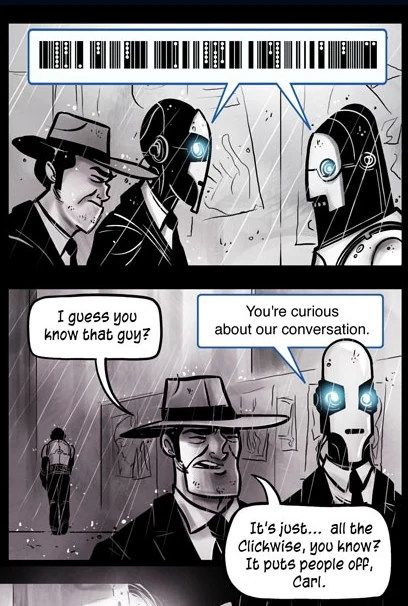
That is what I mean by telepathy here: passing something closer to the agent’s internal signals, with conceptual shorthand that another agent can interpret, so that a handoff can carry more of the context without first squeezing it into an English explanation. The same dependence on shared conventions is still there, just as it is for engineers using jargon or musicians reading a score; the interesting part is what those conventions let us communicate.
This work is already underway in academia: the paper Swarm Telepathy: Prefill-Free KV-Cache Transfer Across Families describes SwaT, a learned mapping from the KV cache built by one model into a form another model can use, allowing the receiver to continue from that context without doing its own prefill over the original text.6
LLMs are already a form of compression, with patterns learned from enormous amounts of language represented in their parameters, yet when we ask them to work together we have them turn what they have worked out back into English for the next model to process. That suggests a similar role for the thoughts an agent needs to pass along: a learned, compressed transfer format that another agent can use without first expanding everything into con-TEXT for it to read again, which is also the direction explored by Interlat, where agents learn to exchange compressed hidden-state representations.
As prompt caching grows, the ability to transfer a KV-cache representation between machines becomes essential for scaling, and the technology to do this is now reaching maturity. Google’s TPU Sync is an example of direct KV-cache transfer, giving us another way to avoid making an agent read the same context again: move that state to a compatible instance of the model and let it continue there. If we duplicate the cache and keep the original running, the analogy starts to look more like teleporting a copy of a mind, as in the machine from The Prestige, than telepathy between two different minds. The original can carry on while another version picks up elsewhere, each following its own continuation of what was, until that point, a shared context.7
And that is why Neocortex has to be a model
And that is why Neocortex has to be a model, because the future of a context provider cannot be to pull some text out of a vector database or a knowledge graph, dump it into a context window, and leave the agent to reconstruct the relationships and meaning we wanted it to have. We would still be paying the cost of legibility at every handoff, turning context into something a person could read so that another model could turn it back into something it could use.
Neocortex has to learn how to represent the context an agent needs and transmit it in the most compact and least ambiguous form that agent can use, preserving the distinctions that matter to the task without requiring an English explanation of each one. That makes the representation itself part of what the model has to learn, along with how to make it useful to the receiving agent, in much the same way that jargon depends on shared concepts and a score depends on musicians who know how to read it.
The future of agent orchestration will be near-instant telepathy, with agents passing usable internal state directly instead of a chain of handoffs where one model decodes a message token by token, only for the next model to tokenize that text and run a long prefill before it can get to work.
The agents already have the tools to perform actions; what we need to give them is the context to know which actions make sense, with as little lost in translation as we can manage. That is the direction I want Neocortex to take: to beam thoughts into the agents that can act on them, so the next agent can pick up the thought and get on with the work.