June 2, 2026
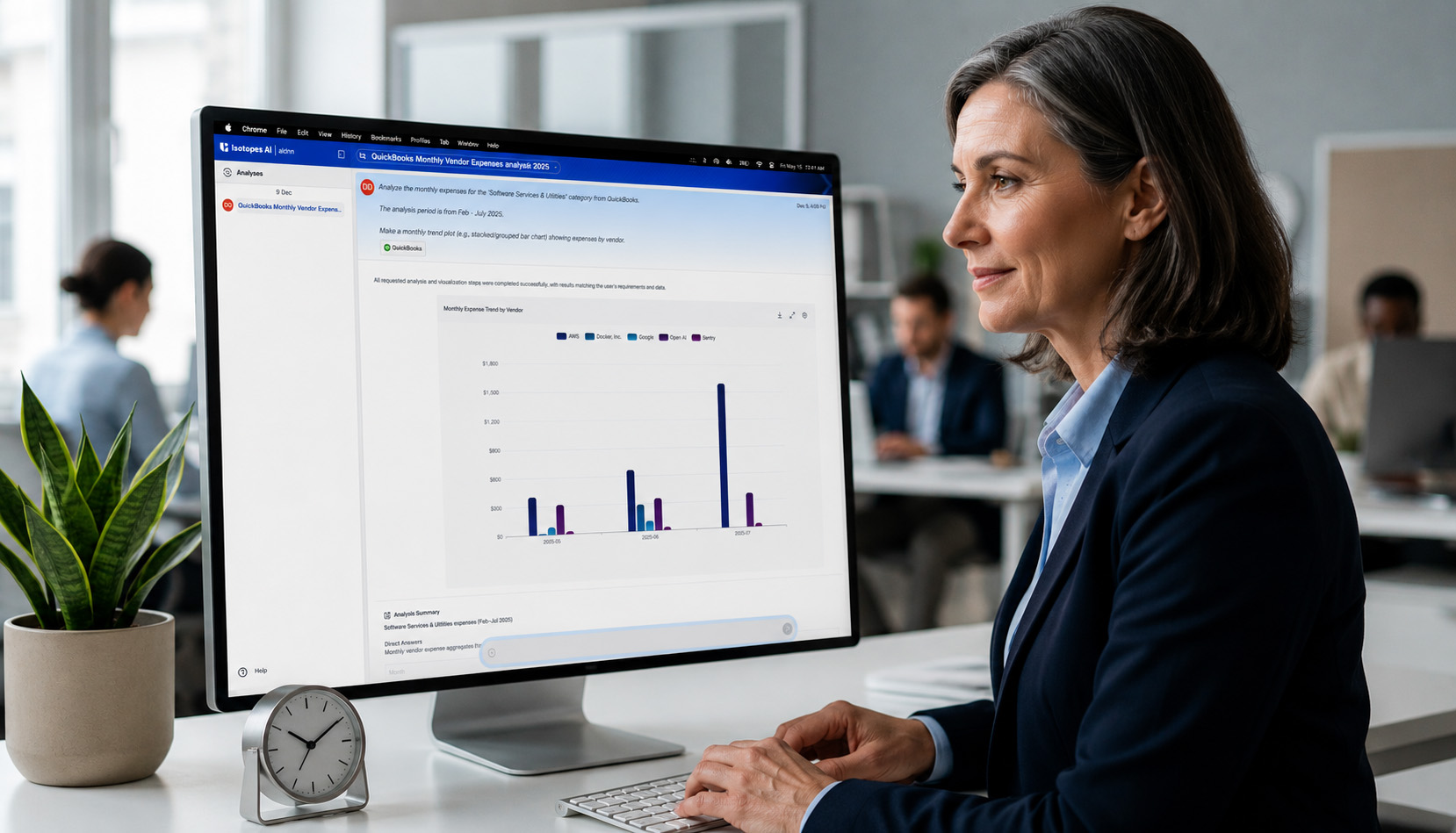
Although AI analytics platforms can reduce hiring pressure and automate reporting, reconciliation, and financial analytics workflows, AI cannot fully replace human business analysts, their judgment, or their strategic decision-making. Instead, enterprise AI analytics systems make analysts significantly more efficient by automating data reconciliation, validating business metrics, and accelerating operational intelligence across fragmented enterprise systems. This allows finance and operations teams to scale faster without analysts becoming bottlenecks in reporting, business intelligence, or decision-making workflows.
The biggest cost in enterprise analytics isn’t analyst salaries. It’s the operational drag created by inconsistent data, manual reporting, and delayed decision-making. Most organizations still rely on analytics teams to reconcile misaligned data, respond to recurring reporting requests, and maintain disconnected dashboards across systems. As data complexity grows, that operating model becomes increasingly difficult to scale.
AI analytics is changing how businesses generate insights, answer questions, and make decisions, but the shift isn’t about replacing skilled analysts. It’s about eliminating the manual workflows, reporting bottlenecks, and disconnected infrastructure that create unnecessary dependency on large analytics teams.
Isotopes AI | aidnn helps organizations remove these bottlenecks by connecting data sources, reconciling inconsistencies, and enabling trusted real-time decision-making through AI-powered analytics.
AI doesn’t fix broken data. It makes the consequences visible faster. Most business data analysts don’t spend their time on insights, they spend it on:
This isn’t strategic analysis, it’s repetitive operational analytics work, and this is exactly where modern AI analytics platforms like Isotopes AI | aidnn create the most value.
When built on trusted, reconciled data, AI analytics can dramatically reduce the need for traditional analyst workflows. The biggest impact isn’t in replacing insight, it’s in eliminating the repetitive work that surrounds it.
Manual reporting requests and on-demand questions are often the first to go. Instead of waiting on SQL queries or dashboard updates, teams can ask questions directly and get immediate answers, from revenue trends to conversion performance to churn drivers. With Isotopes AI | aidnn, those answers are grounded in validated, cross-system data, not fragmented or conflicting sources.
The same shift applies to dashboard maintenance and recurring KPI reporting. What once required constant updates, interpretation, and explanation can now be automated. AI can generate real-time summaries, highlight meaningful changes, and explain why metrics moved, reducing the need for analysts dedicated to routine reporting cycles.
Data quality monitoring also becomes significantly more efficient. Modern platforms can detect inconsistencies, missing data, and unexpected anomalies automatically. But detection alone isn’t enough. Isotopes AI | aidnn goes further by reconciling issues at the source, ensuring that downstream insights remain accurate and decision-ready.
As a result, even early-stage analysis begins to change. Instead of starting from raw, inconsistent data, teams can begin with information that is already reconciled and trusted. AI can then identify trends, suggest hypotheses, and generate initial insights, accelerating exploratory work and reducing the need for manual analysis. With Isotopes AI | aidnn, these insights are not just faster, they’re built on data that teams can actually rely on.
Reducing analyst headcount isn’t about removing people, it’s about changing how analytics works across the business. Most organizations are still operating on a model built around manual workflows, fragmented data, and constant requests for answers.
A modern approach replaces analyst-heavy workflows with systems that deliver trusted, real-time insights automatically, so teams can move faster without relying on manual reporting.
Reducing reliance on analyst-heavy teams is not about doing less work. It is about redesigning how enterprise analytics operates across the business. Most organizations still rely on siloed data, manual reporting workflows, and constant requests for answers from centralized analytics teams. That model becomes difficult to scale as data complexity and operational demands increase.
A better approach replaces manual analytics workflows with systems that deliver trusted, real-time insights automatically, enabling teams to make faster decisions without waiting on analysts or disconnected reporting pipelines.
AI can automate reporting and accelerate analytics, but trusted enterprise data still requires human ownership. A small, focused core data team remains essential because their role evolves from producing reports to maintaining the systems, definitions, and governance that make reliable AI-driven analytics possible across the organization. Their responsibility shifts toward:
This creates the foundation that allows AI analytics systems like Isotopes AI | aidnn to scale trusted insights across the business without sacrificing consistency or operational confidence.
Most analytics teams spend too much time supporting repetitive operational workflows instead of driving strategic business insights. Reporting requests, dashboard maintenance, data monitoring, and recurring analysis create constant bottlenecks that slow decision-making across the organization. Once enterprise data is trusted, reconciled, and unified across systems, many of these workflows can be automated reliably. That includes:
With Isotopes AI | aidnn, analytics teams can reduce manual operational work while improving the speed, consistency, and scalability of enterprise decision-making. Instead of spending time reconciling data and answering repetitive questions, teams can focus on higher-value analysis, planning, and operational strategy.
When enterprise data is unified, reconciled, and trustworthy, analytics no longer stays confined to centralized data teams. Trusted insights become accessible across the organization, enabling teams to make faster decisions without waiting on manual reporting cycles or analyst support. That includes:
This is where the operating model fundamentally changes. Analytics shifts from a centralized reporting function into a real-time decision layer embedded throughout the business. Teams no longer wait for answers. They operate with continuous access to trusted intelligence.
All of this only works if the underlying data is usable. In most organizations, it isn’t. Data is spread across systems, defined differently across teams, and often inconsistent at the source. Without fixing that, AI doesn’t improve analytics, it accelerates confusion.
For AI analytics to actually replace manual workflows, data must be consistent across systems, reconciled at the source, and defined with clear, governed metrics. This is where most tools fall short. They focus on querying and reporting, but ignore the work required to make data reliable in the first place.
This is the foundation of Isotopes AI | aidnn. Instead of layering AI on top of broken data, Isotopes AI | aidnn connects systems, resolves inconsistencies, and ensures data is usable before analysis begins. That’s what makes automation safe and what makes insights trustworthy.
Once that foundation is in place, the role of analysts begins to shift. They’re no longer responsible for answering routine questions or maintaining dashboards, but instead, they focus on higher-value work, like interpreting results, designing experiments, and guiding business decisions where context and judgment matter most.
In practice, reducing reliance on analyst-heavy workflows comes from eliminating the work around them. Organizations start by consolidating dashboards, replacing ticket-based reporting with reusable data products, and automating reporting, monitoring, and insight generation. Analysts aren’t removed, they’re redeployed into roles that drive more impact.
There are still risks if this transition isn’t handled carefully. Inconsistent data can lead to unreliable outputs. Over-automation can remove necessary human oversight. And without proper access controls, sensitive data can be exposed. But these risks are manageable when the system is built on reconciled, governed data and when humans remain accountable for decisions.
Reducing analyst headcount isn’t about replacing people with AI, instead it’s about eliminating the manual data workflows that make analysts necessary in the first place. Most organizations don’t have a talent problem, they have a data problem.
When data is inconsistent, fragmented across systems, and difficult to trust, teams are forced into manual reporting, constant validation, and slow decision-making. Adding AI on top of that doesn’t fix the issue—it accelerates it.
With platforms like Isotopes AI | aidnn, the approach is fundamentally different. By connecting systems, reconciling inconsistencies, and ensuring data is usable before analysis begins, businesses can automate reporting, generate trusted insights in real time, and remove the friction that slows teams down.
The result isn’t fewer insights, it’s faster, more reliable decisions across the business. Teams spend less time fixing data, less time waiting for answers, and more time acting on them.
Isotopes AI | aidnn is built for organizations that have outgrown manual reporting, siloed reporting infrastructure, and unreliable business intelligence workflows. By reconciling fragmented enterprise data and automating reporting, analysis, and operational insight generation, Isotopes AI | aidnn enables teams to access trusted, decision-ready analytics in real time without the delays, bottlenecks, or manual grunt work that slow modern businesses down. See how enterprise AI analytics can deliver smarter insights beyond QuickBooks.
Click here to see a demo of what trusted enterprise AI analytics looks like in practice.