June 2, 2026

Most companies track revenue, but the best SaaS and enterprise AI companies track how customers expand over time through Net Revenue Retention (NRR), one of the most important metrics in cloud software and AI analytics platforms. Snowflake’s high NRR showed the market that enterprises continue expanding usage when a platform becomes deeply embedded into how teams manage, trust, and operate on data. That same shift is now happening across AI analytics, where companies are looking for platforms like Isotopes AI | aidnn that can automate insights, reconcile fragmented data, and support more reliable business decision-making at scale.
NRR, or Net Revenue Retention, measures whether existing customers are spending more, less, or the same amount over time. In enterprise software, cloud computing, and AI analytics platforms, NRR is one of the clearest indicators of customer retention, product-market fit, and long-term platform adoption because it shows whether customers continue expanding usage after the initial purchase. In simple terms, NRR answers one question:
Are customers becoming more invested in the product over time?
Think of it like this: a company starts with revenue from its existing customers, then evaluates how those accounts changed over the next year. Some customers may upgrade their plans, expand usage across teams, or increase adoption throughout the organization, while others may reduce spending or leave the platform entirely.
If a company starts with:
…then the company has 130% Net Revenue Retention (NRR).
That signals something important to investors, SaaS operators, and enterprise AI companies: customers are not just renewing contracts, they are becoming more dependent on the platform over time. This is especially important for modern AI analytics and business intelligence platforms like Isotopes AI | aidnn, where long-term value increases as organizations expand data usage, automate workflows, and integrate AI-driven insights across more teams and departments.
Snowflake’s Net Revenue Retention (NRR) became one of the most closely watched metrics in enterprise software because it demonstrated what happens when a cloud data platform becomes deeply embedded into how organizations operate. Instead of relying solely on acquiring new customers, Snowflake showed investors, SaaS operators, and enterprise technology leaders that the strongest software companies can compound revenue by expanding usage within existing accounts over time.
At one point, Snowflake reported NRR above 170%, a number that stood out across cloud computing, enterprise SaaS, and AI analytics because it showed customers were dramatically increasing adoption after the initial purchase. That shifted how the market evaluated enterprise software growth. High NRR became more than a finance metric. It became a benchmark for:
Snowflake helped redefine what elite SaaS growth looked like across cloud infrastructure, business intelligence, and enterprise AI platforms.
One of the biggest reasons Snowflake maintained high Net Revenue Retention is because the platform became deeply embedded into enterprise operations, analytics workflows, and cloud data infrastructure. As organizations relied more heavily on Snowflake for reporting, forecasting, and business intelligence, the platform evolved into a core part of enterprise decision-making and operational scale.
Snowflake’s NRR became a benchmark for enterprise SaaS growth because existing customers consistently expanded platform usage after the initial purchase. As adoption scaled across teams and enterprise data workloads increased, Snowflake drove recurring revenue growth through customer expansion and long-term account retention rather than relying solely on new customer acquisition.
High Net Revenue Retention became one of the strongest indicators of enterprise product-market fit because it showed that customers were not only staying on the platform, but continuing to expand usage over time. For investors, SaaS operators, and enterprise technology leaders, strong NRR signaled platform stickiness, long-term customer value, and the ability to sustain scalable recurring revenue growth.
The same dynamics that drove Snowflake’s long-term growth are increasingly shaping the future of enterprise AI analytics platforms, where customer retention depends on trusted data, scalable workflows, and operational adoption across the organization. Platforms like Isotopes AI | aidnn are part of this shift toward AI-driven analytics, automated reporting, and enterprise business intelligence systems that become more valuable as companies expand usage over time.
As enterprise AI adoption accelerates, Net Revenue Retention has become one of the clearest indicators of whether an AI analytics platform is delivering long-term business value. The market is now crowded with AI copilots, generative reporting tools, AI agents, and automated analytics platforms, but many of these products struggle with customer retention because they generate insights without solving the underlying problem of data trust and consistency.
When analytics outputs are inaccurate, dashboards conflict across teams, or finance and operations report different numbers, organizations quickly lose confidence in the platform. In the AI era, high NRR signals more than recurring revenue growth. It reflects whether companies trust a platform enough to expand adoption across workflows, departments, and operational decision-making over time, which is why enterprise AI analytics platforms like Isotopes AI | aidnn are increasingly focused on trusted data infrastructure, automated analytics, and cross-system intelligence rather than surface-level AI outputs alone.
Most enterprise analytics platforms assume the underlying data is already accurate, consistent, and ready for analysis, but enterprise data systems are often fragmented in ways that create reporting inconsistencies, operational blind spots, and unreliable analytics across the organization:
This creates enormous operational friction across the organization. Teams stop trusting dashboards, executives revert to manual spreadsheet exports, and analysts spend more time reconciling data than generating business insights.
As enterprise AI adoption grows, this has become one of the biggest unsolved problems in AI analytics, business intelligence, and automated reporting workflows. This is also why platforms like Isotopes AI | aidnn are increasingly focused on trusted analytics, data reconciliation, and cross-system intelligence, helping organizations unify fragmented enterprise data before AI-driven insights and automated decision-making occur.
Isotopes AI | aidnn is positioned around a fundamentally different idea: AI analytics only become valuable when the underlying enterprise data can be verified, reconciled, and trusted across systems. Instead of focusing purely on dashboards or AI-generated summaries, the platform aligns with emerging categories like verified analytics, AI data validation, data reconciliation automation, trusted AI analytics, and multi-agent analytics systems.
These capabilities are becoming increasingly important because enterprises do not just want faster analytics. They want reliable AI-driven insights that can support financial reporting, operational planning, forecasting, and enterprise decision-making at scale. As organizations continue investing in enterprise AI, business intelligence, and automated analytics platforms, trust in the underlying data infrastructure is becoming one of the most important drivers of long-term customer retention and platform adoption.
This is also where long-term Net Revenue Retention dynamics become important. Snowflake achieved strong NRR because data usage naturally expanded across organizations over time, and the same expansion model could apply to enterprise AI analytics platforms built around trusted data infrastructure and cross-system intelligence.
A company may initially adopt AI analytics for:
But once trusted reconciliation workflows are established, adoption can naturally expand into operations, forecasting, manufacturing analytics, supply chain intelligence, cross-system validation, and real-time anomaly detection. That creates the foundation for larger enterprise deployments, deeper workflow adoption, more users across departments, and stronger operational dependency over time.
Ultimately, this is how enterprise AI platforms evolve from useful software tools into operational systems organizations rely on every day, becoming deeply embedded into analytics workflows, enterprise decision-making, and the long-term infrastructure that drives scalable business growth.
Want to see how Isotopes AI | aidnn integrates directly with Snowflake to automate Net Revenue Retention (NRR) analysis using enterprise billing data? Our interactive demo shows how Isotopes AI | aidnn generates NRR insights from Snowflake billing data, then visualizes MRR (Monthly Recurring Revenue) and NRR metrics through an approval-driven analytics workflow. See how Isotopes AI | aidnn quickly generates NRR using your billing data in Snowflake, then plots both MRR and NRR dashboards once your plan is approved.
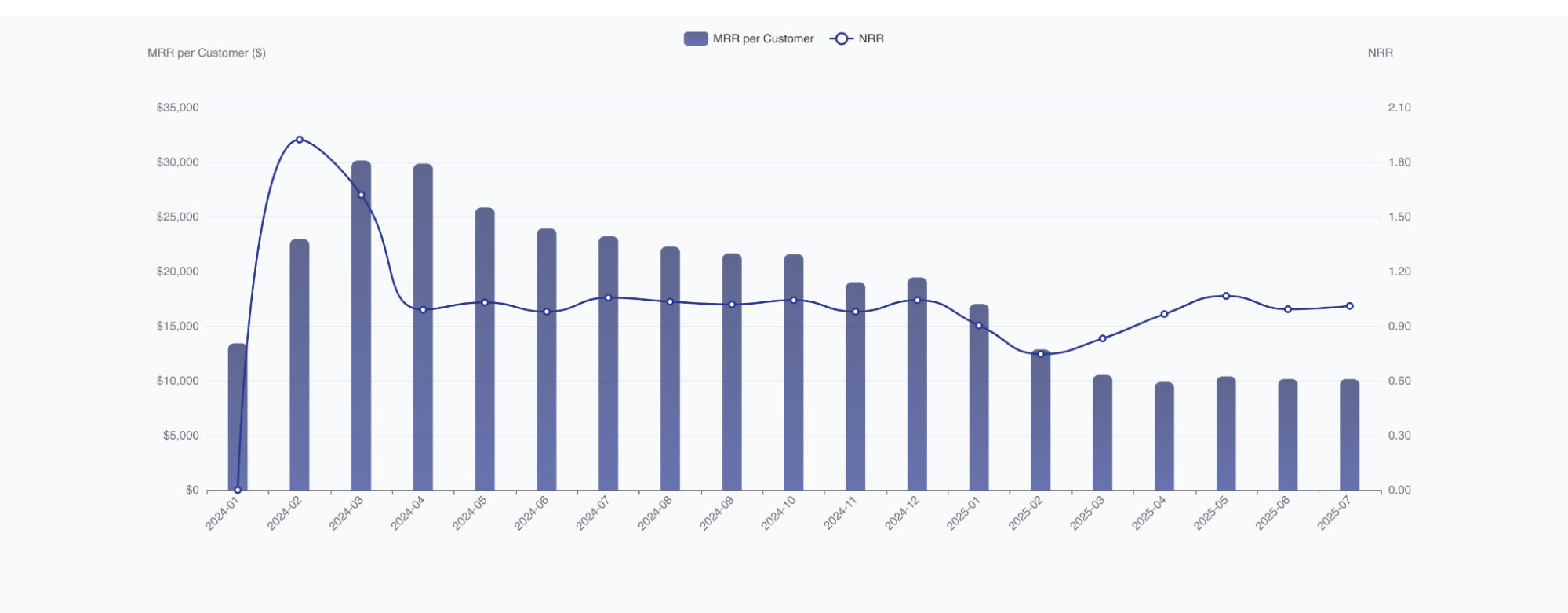
This interactive demo shows aidnn’s capability to connect to billing data inside a Snowflake data warehouse, extract metadata, prorate SaaS revenue, and map out Net Revenue Retention (NRR) and Monthly Recurring Revenue (MRR) metrics without manual SQL engineering.
If you are searching for a Snowflake NRR solution capable of computing SaaS retention metrics from historical billing data, this interactive demo shows how Isotopes AI | aidnn connects directly to Snowflake to automate the process. By extracting metadata, prorating SaaS revenue, reconciling fragmented billing and usage data, and generating approved Monthly Recurring Revenue (MRR) and Net Revenue Retention (NRR) visualizations, Isotopes AI | aidnn mirrors the real-world enterprise finance workflow without requiring manual SQL engineering. As an agentic AI analytics coworker, Isotopes AI | aidnn helps organizations transform raw cloud data into trusted, real-time business intelligence across complex enterprise systems.
Want to see how AI-powered analytics can automate NRR reporting at scale? Try the Snowflake NRR Demo.