June 11, 2026
In a world with abundant intelligence, every enterprise runs on two kinds of capital: the human capital of its people's judgment, and the cognitive capital of the reasoning ability it builds and owns about the business. The second is new, and it is where durable advantage now accrues.
White-collar work in the enterprise forms a natural hierarchy. At the base sit the systems of record, the warehouses, lakes, ERPs, and CRMs that hold the data. Above it comes knowledge work: the assembly, reconciliation, and verification that turn scattered records into a trustworthy answer, procedural even when hard, and staffed today by armies of analysts and outsourced teams. At the top comes judgment work: weighing trade-offs when systems disagree, owning the answer when challenged, the part that was always worth paying for. Knowledge work is human capital that software increasingly absorbs; judgment work is human capital it still needs. Cognitive capital accrues there, and only when both kinds of work are done together, every cycle, with what was learned carried forward. The real trouble with AI right now isn’t just the errors, it’s missed opportunities because of missing information. One cannot know what’s missing without activities to observe it.

Every organization runs on a community of experts. Finance owns revenue recognition. Supply chain owns inventory classification. Clinical operations owns patient cohort definitions. When a hard question comes up, the answer is not retrieved from a single source of truth. It is composed: the question goes to the right experts, each weighs in from their own authority, and a coherent answer emerges. That is how organizations actually think.
Today we are introducing NeoCortex, the self-learning model that powers aidnn. NeoCortex thinks the same way: a mixture of experts drawn from your organization's verified knowledge, gated by reasoning about what each question actually asks, synthesized into answers that show every expert who contributed and every belief relied on.
NeoCortex learns from doing the work, not from instructions you write down for every task. Every correction shows it how the work should be done, and the one thing it does better than any tool you have used is this: it never needs to be told twice.
In the last generation of tools, memory is a transcript log dressed up with summarization, and the time spent writing it has to be earned back through repeated use. But the knowledge that makes your organization run, the rules, the definitions, the tribal knowledge in your senior people's heads, cannot be written out as a linear set of steps. In the absence of a brain on the other side, you write prompts longer than your scroll bar, forget something, and explain it again for the millionth time.
Before we get to architecture, it is worth being precise about biology, because the point is not that software should imitate the brain literally. The point is that durable intelligence has three design requirements: multiple memory timescales, offline consolidation, and a mechanism for deciding what becomes stable knowledge. Those three requirements become NeoCortex’s authority tiers, dreamtime, and review workflow.
Human memory is not a single store. It operates across multiple timescales. Working memory holds what is active in the moment. The hippocampus helps rapidly encode recent declarative experience and bind it to context. Over time, especially during slow-wave sleep, replay helps stabilize useful patterns and integrate them into neocortical representations. What emerges is not a transcript of experience, but a more durable semantic model of the world: rules, relationships, and expectations that can be reused without being re-derived.
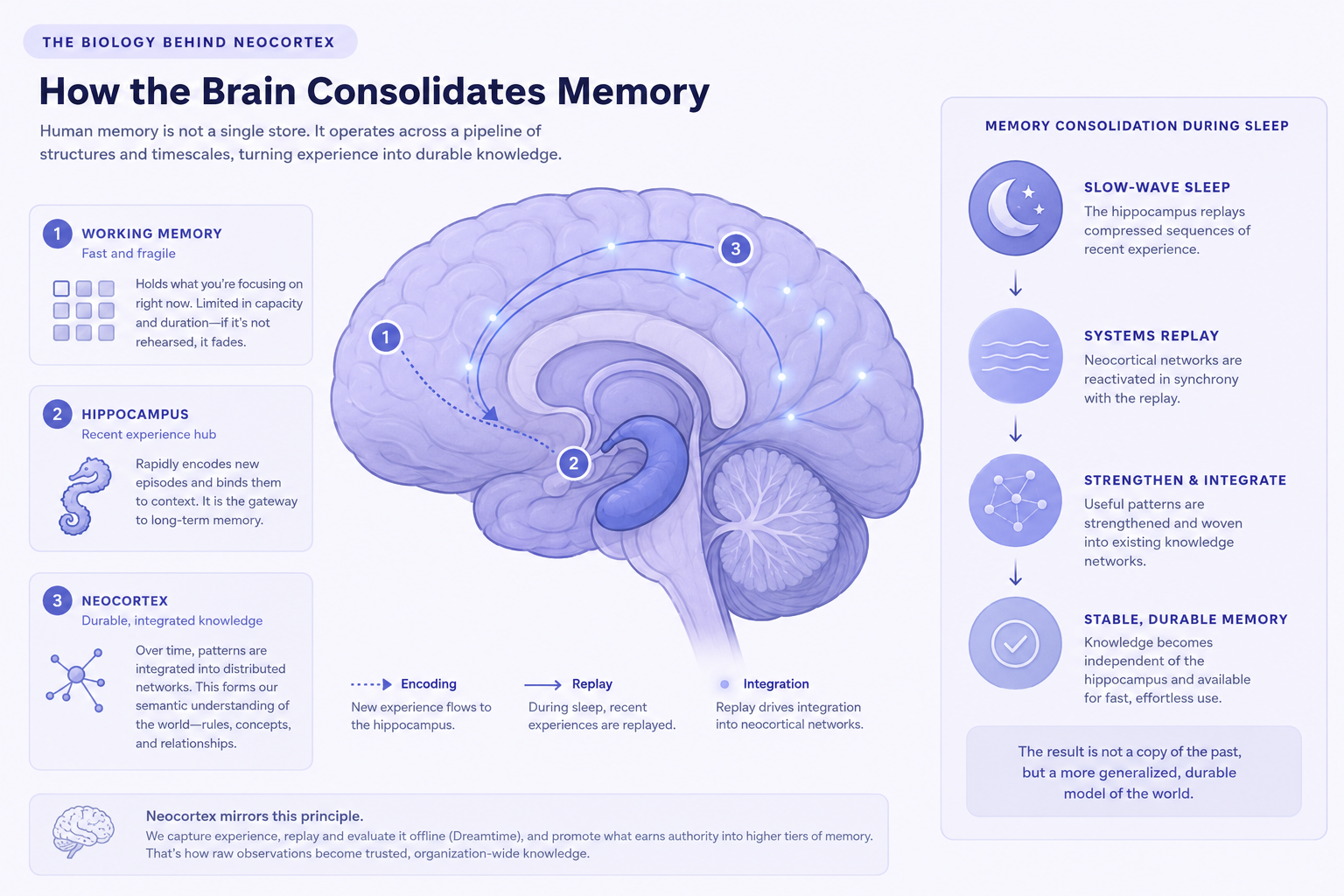
Durable intelligence has three design requirements: multiple memory timescales, offline consolidation, and a mechanism for deciding what becomes stable knowledge. Human memory works this way, fast and fragile at the surface, consolidated during sleep into a durable model of rules and relationships that can be reused without being re-derived. The same insight appears in machine learning as experience replay. NeoCortex applies the principle to organizational knowledge: recent observations are useful but fragile, repeated or validated patterns become durable, and the movement between layers happens offline through consolidation, validation, and human review. Those three requirements become NeoCortex's authority tiers, dreamtime, and review.
Once memory is shared across an organization, the problem stops being recall and becomes governance. An enterprise knowledge layer has to satisfy constraints that are non-negotiable at scale.
An analyst's mid-session correction is not the same kind of write as an admin's metric update, and neither is the system learning from usage. Each needs its own review path, audit trail, and level of trust. NeoCortex puts an actor on every row and a transition history on every fact.
The boundary between accounts has to be structural, not a convention. NeoCortex isolates every tenant at the database layer, with its own catalog, indexes, and vector space, because two organizations use the same words to mean different things and any shared embedding space lets their meanings collide.
Six months from now, someone will ask why the system reported a particular number in March. The only acceptable answer is a full reconstruction: every fact the answer depended on, its version at that moment, who authored or validated it, and what has changed since. Knowledge versions at the fact level, not the document level.
NeoCortex is a model, not a retrieval pipeline glued onto a foundation model or a wrapper that injects context into a chat completion. By model, we mean a governed, customer-specific reasoning system whose behavior is shaped by accumulated organizational knowledge. The architecture is closer to a mixture of experts than a pipeline: every domain, rule set, and schema understanding is a specialist Neocortex can call on, the agentic loop is the routing mechanism, and the synthesis is what Neocortex does after the relevant experts weigh in.
What sets it apart is that the model is built per customer. NeoCortex learns each organization's vocabulary, definitions, and conventions through consolidation rather than configuration, so two customers get two different models on the same foundation of explainable reasoning. Inside, facts and behavior are kept separate. Facts, rules, lineage, and schemas live in a governed knowledge layer where they can be cited and audited; conventions and reasoning patterns are absorbed into the model itself. Nothing is hidden in the weights that belongs in the catalog, and nothing is forced through the catalog that belongs in the weights.
When NeoCortex answers a real question, the work happens in a loop, not a single pass: reason, consult, act, verify, consult again if needed, and only then advance.
Suppose a user asks why East region revenue dropped in Q3. NeoCortex consults the verified definition of "revenue" and finds it is recognized at shipment, not invoice. That changes what comes next. It consults the definition of "East region," which turns out to mean sales territory, and that prompts one more consultation: the rules for mid-quarter territory reassignments, since a reassignment could shift revenue between regions with no real business change. Only now does it have enough grounded context to plan. Three rounds of consulting experts, each shaped by what the previous one revealed, none planned in advance. The important part is not that it retrieved three facts. It is that each fact changed what it knew to ask next.
Every piece of knowledge lives in one of four authority tiers, and the tier determines how heavily that expertise is weighted when NeoCortex synthesizes an answer.
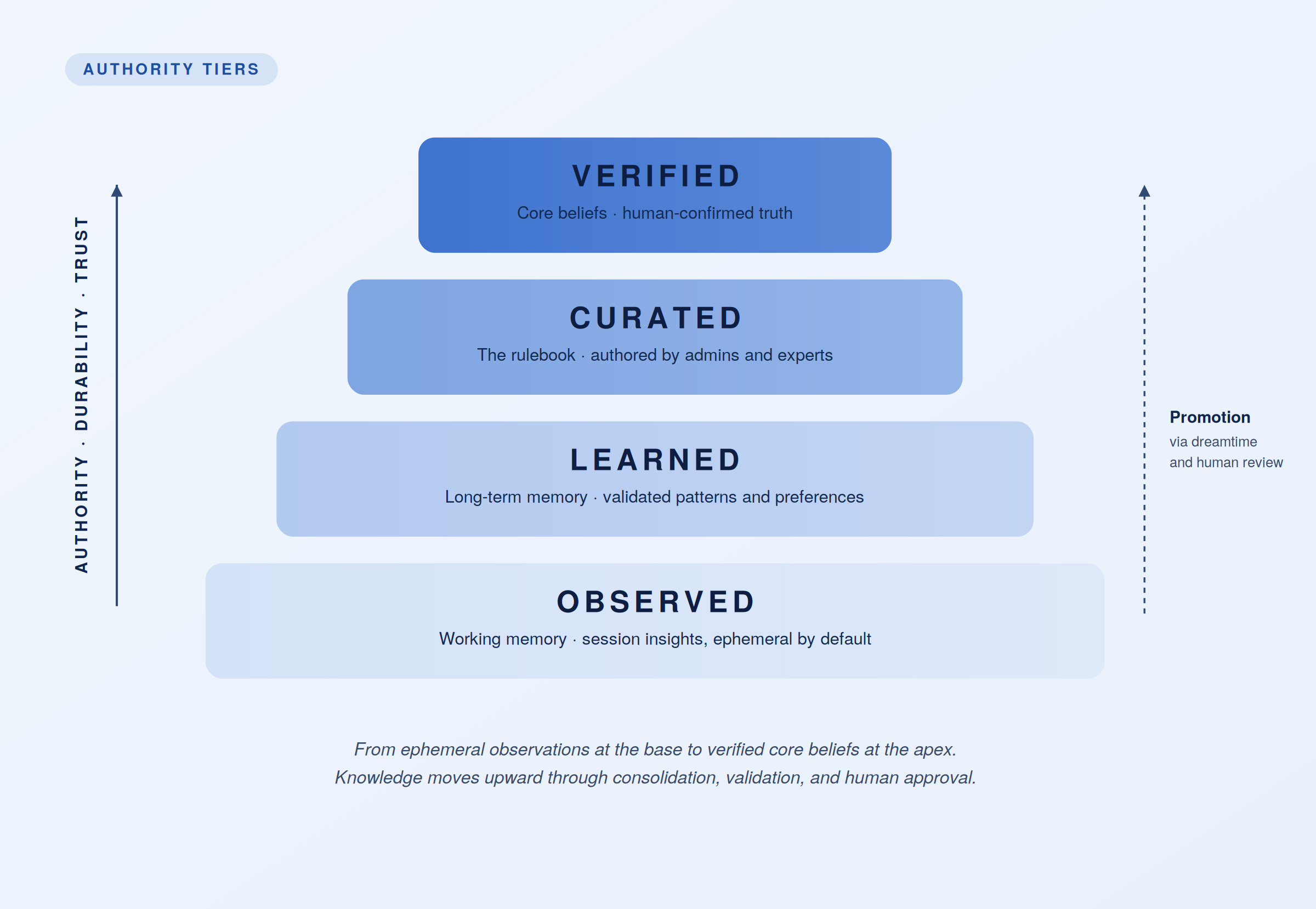
Things NeoCortex noticed during a session. Useful in the moment, but most expire unless something validates them.
Patterns seen often enough, or validated explicitly, to carry forward. Not yet policy, but stable enough to inform future work.
Business rules, schemas, lineage, and reference data that administrators and domain owners authored on purpose. It outranks anything NeoCortex learned on its own.
The first is human resolution: when lower tiers contradict, an administrator decides which side is correct. The second is subject matter expertise, the finance expert's understanding of revenue recognition, the clinical expert's understanding of cohort definitions. NeoCortex treats expert knowledge as a first-class input into the verified tier, cited and attributed, so the authority is visible whenever an analysis leans on it.
"Verified" is not a stamp granted on trust. It is what an entry earns by surviving a multi-stage validation pipeline. Inline, rival agents audit each analysis and surface disagreements before any answer reaches the user. Offline, deep validation replays entries against historical analyses, runs eval suites, and applies formal methods where the claim allows. Verified analytics means exactly this: every answer traces back to entries continuously validated, at intensities appropriate to their authority, by methods an auditor could reproduce. When two entries contradict, the system surfaces both rather than silently picking a winner.
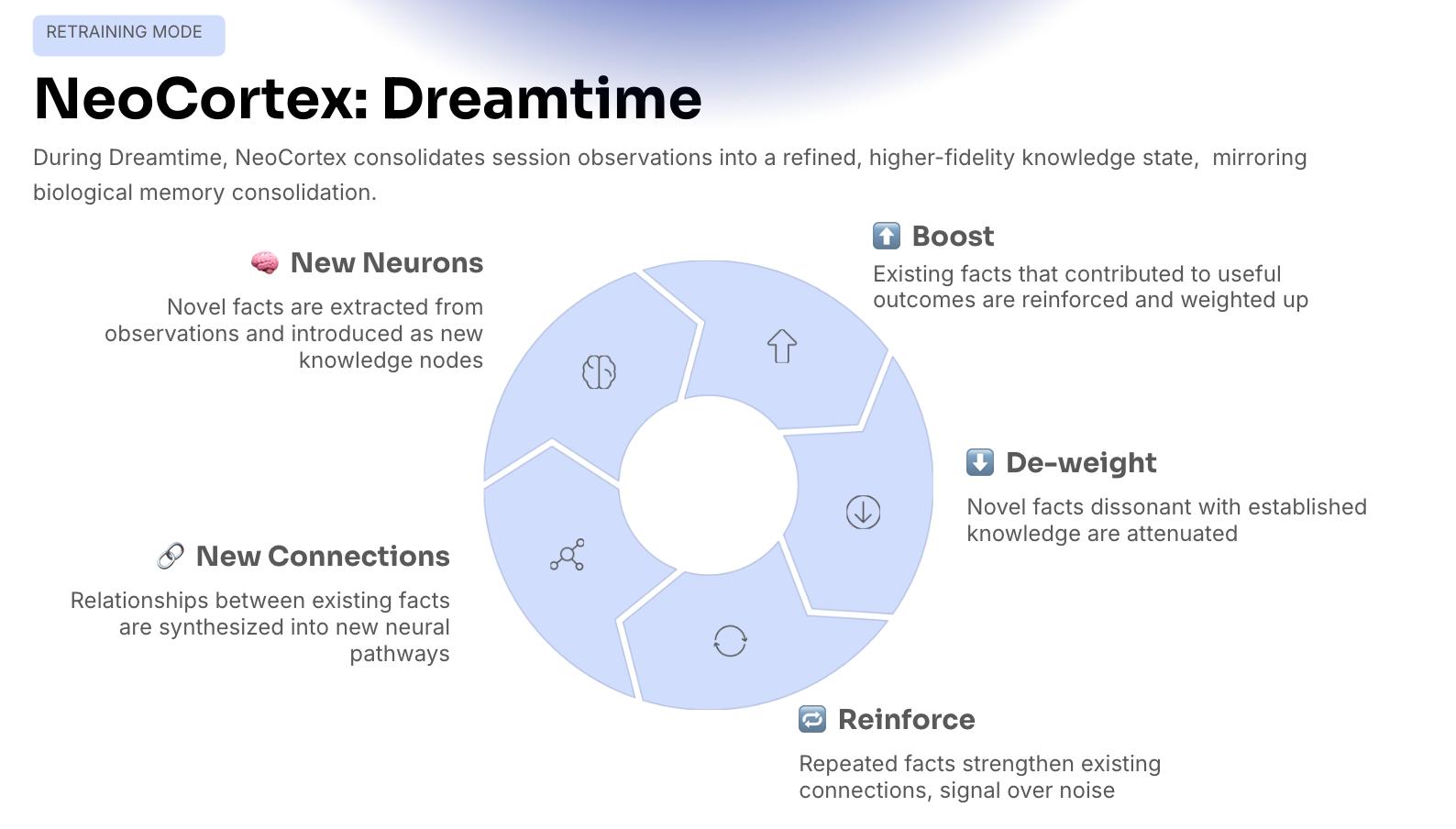
The brain does not decide what becomes long-term memory while you are awake; the work happens during sleep, when experience is replayed, patterns extracted, and noise pruned. NeoCortex runs the same kind of process offline, outside the user's active workflow. We call it Dreamtime. It refines the mixture of expertise NeoCortex routes to: new patterns become candidate experts, useful ones get reinforced, conflicting ones get de-weighted, and observed patterns seen often enough get promoted toward learned and curated.
Here is the part most self-learning pitches gloss over: dreamtime synthesizes the candidate and then stops. It does not promote itself. Every candidate carries an exposure analysis: before the admin acts, NeoCortex replays it against the existing body of work and reports the blast radius, which past answers shift, which become inconsistent, which break. Approve, and it takes effect immediately. Edit, and the new version is re-evaluated against the same surface. Dismiss, and it is logged so it is not re-proposed. An approval that is just a click is not governance; an approval that comes with a quantified exposure analysis is. Dreamtime proposes; administrators and domain experts decide.
Capturing knowledge is not the hardest problem in enterprise cognition. Reconciling knowledge that disagrees is. A session insight says the fiscal year starts in January; the rulebook says April. These contradictions are inevitable across systems and across time, and the question is whether your model surfaces them or buries them. NeoCortex surfaces them during the session, where a contested fact reaches the user with both sides cited; during dreamtime, where consolidation doubles as a coherence check that flags stale or conflicting entries; and in the review panel, where an admin resolves the conflict, often with the relevant expert, and the resolution becomes a verified fact with the dissonance record attached as evidence.
The losers do not disappear. They are soft-deleted and marked as superseded, with a pointer to the winner, so old analyses still resolve cleanly while showing that the citation was superseded, by whom, when, and why. Nothing is quietly rewritten and nothing is orphaned.
Every fact in NeoCortex has a stable identity. Click a citation and you see the fact, its tier, its source, its validation history, and the chain of transitions that brought it to its current state. Every step in an analysis is explainable as a structural property of how the system works, not a post-hoc summary: the plan references rules, the rules reference facts, the facts reference versioned sources. There is no point in the chain where the answer rests on something you cannot inspect. Most AI analytics tools treat memory as an internal optimization. Neocortex treats it as a first-class part of the output, because where decisions have consequences, the reasoning has to be as auditable as the conclusion.
Most AI analytics tools answer questions. The harder questions are what they actually know, how they know it, and what happens when they are wrong. NeoCortex answers all three: a model that thinks the way your organization thinks, continuously validated, governed by the people whose expertise the organization runs on, and explainable at every step. Your data is fragmented and your knowledge is fragmented. The question is whether your AI was built to make sense of both, together, durably, and out in the open.
aidnn is the most sophisticated AI agent for analytics, delivering verified, source-traced answers from wherever your data lives.